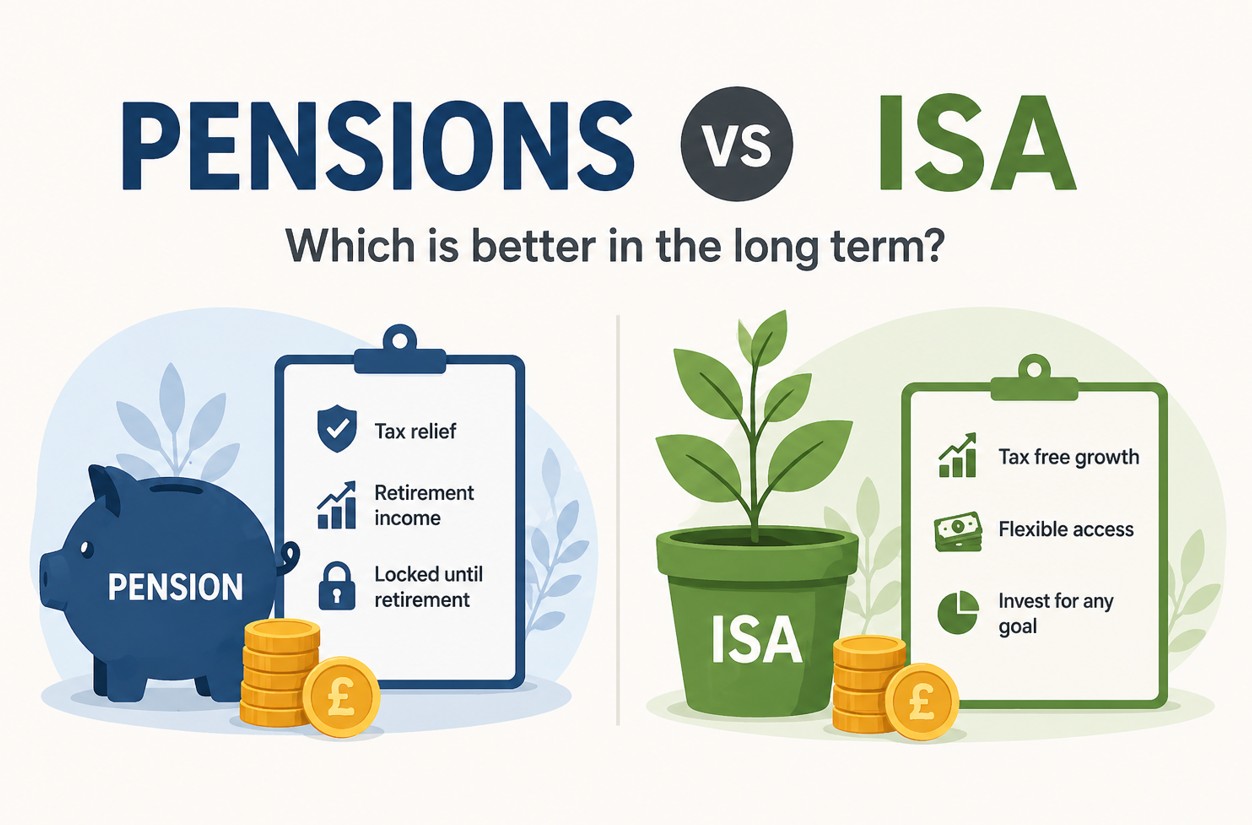
Pensions vs ISA: Which Is Better for the Long Term in the UK (2026)
Key Points at a Glance
- Pensions usually win on raw returns thanks to tax relief (20%, 40% or 45%) and employer contributions, but your money is locked away until age 57 from 2028.
- ISAs win on flexibility and simplicity. The £20,000 annual allowance grows tax-free, withdrawals are tax-free, and you can access funds at any age.
- For a higher-rate taxpayer, £100 in a pension costs only £60 of take-home pay; the same £100 in an ISA costs the full £100.
- The full new State Pension is £12,547.60 a year in 2026/27. On its own, it does not fund a comfortable retirement.
- The smart answer for most migrants is both: pension first to capture employer match and tax relief, then ISA for flexibility and early access.
Executive Summary
The pensions vs ISA debate is one of the most consequential financial decisions a migrant in the UK will ever face. Get it right and a comfortable retirement is realistic. Get it wrong and decades of compound growth can be wasted on the wrong wrapper.
The honest answer, hidden behind every glossy article on the topic, is that the two products are not really competing — they are complementary. A pension delivers unmatched tax relief and, where applicable, free money from an employer. An ISA delivers unmatched flexibility and tax-free access at any age. The question is rarely “which one” but “in what proportion, and in what order”.
This guide unpacks the rules as they stand for the 2026/27 tax year, runs the numbers on a realistic comparison, and shows how migrants in the UK can structure both accounts to build genuine long-term wealth — not just survive on the State Pension.
Why This Decision Matters More for Migrants
Most generic pension vs ISA articles assume a reader who has lived in the UK their whole life, has a clear retirement timeline, and knows they will end up drawing a UK pension. Migrants rarely have that certainty.
A migrant might leave the UK in five years, ten years, or never. Money tied up in a pension cannot be touched until age 57 (rising from age 55 in April 2028), regardless of where the holder lives. Funds in an ISA can be withdrawn at any time — but only UK residents can subscribe new money to an ISA, and ISAs lose much of their tax efficiency once the holder moves abroad.
Add to this the fact that most migrants arrive in the UK with no UK pension history and only build State Pension entitlement from the year they receive their National Insurance number, and the trade-offs become unique. This article addresses those realities head-on.
What Is a Pension? The UK System Explained
The Three Pension Layers in the UK
“Pension” is one word doing a lot of work in the UK. It actually refers to three distinct things, and most workers end up with all three:
- State Pension — A weekly payment from the government once you reach State Pension age (currently 66, rising to 67 between 2026 and 2028, then 68 after that). To qualify for the full new State Pension of £241.30 per week (£12,547.60 per year for 2026/27), you need 35 qualifying years of National Insurance contributions. You need at least 10 qualifying years to get any State Pension at all.
- Workplace pension — If you earn over £10,000 a year and are aged 22 or over, your employer must auto-enrol you. The legal minimum total contribution is 8% of qualifying earnings, of which your employer pays at least 3%.
- Personal pension or SIPP — A pension you set up yourself, ideal for the self-employed or for anyone who wants to top up their workplace pension with more investment choice. A Self-Invested Personal Pension (SIPP) gives you full control over what your money is invested in.
How Pension Tax Relief Actually Works
Tax relief is the single most powerful feature of a UK pension, and it works at your highest rate of income tax:
- Basic-rate taxpayer (20%) — Every £80 you contribute is topped up to £100. That is a 25% instant uplift on what leaves your bank account.
- Higher-rate taxpayer (40%) — Every £60 of take-home pay buys £100 in your pension. That is a 66.7% boost, claimed partly through your provider and partly through Self Assessment.
- Additional-rate taxpayer (45%) — Every £55 of take-home pay buys £100 in the pension. An 81.8% uplift before any investment growth.
This is not a marketing slogan. It is the rate the government will gross up your contribution at, regardless of which provider you use. For a 2026/27 tax year, the annual allowance — the maximum that can go into all your pensions combined and still attract relief — is £60,000 or 100% of your earnings, whichever is lower.
The Catch: When You Can Access It
Pensions trade tax efficiency for liquidity. You cannot touch your pension money until age 55, and that minimum age rises to 57 from 6 April 2028. When you do access it, the first 25% can be taken tax-free (capped at £268,275); the remaining 75% is taxed as income at your marginal rate at the time.
For a basic-rate taxpayer in retirement, the effective tax rate on a pension withdrawal is roughly 15% — because of the 25% tax-free portion combined with 20% income tax on the rest. That is genuinely attractive compared to receiving the original income, paying tax on it, and saving from net pay.
What Is an ISA? The Tax-Free Savings Wrapper
The Basics of an Individual Savings Account
An Individual Savings Account is a tax-free wrapper around your savings or investments. Any income or growth inside the wrapper escapes UK income tax, dividend tax and capital gains tax — for life. There are four main types:
- Cash ISA — A tax-free savings account. Interest accrues at whatever rate the provider offers. Note: from April 2027, the cash ISA allowance for under-65s drops from £20,000 to £12,000.
- Stocks and Shares ISA — Holds shares, ETFs, funds and investment trusts. The wrapper of choice for long-term wealth building.
- Lifetime ISA (LISA) — £4,000 annual limit, with a 25% government bonus on top. Reserved for first-home purchase or retirement after age 60. Only people aged 18 to 39 can open one.
- Innovative Finance ISA — Holds peer-to-peer loans. Niche; ignore unless you specifically know what you are doing.
The total annual ISA allowance for 2026/27 is £20,000, shared across all types. You do not have to spread it — you can put the whole £20,000 into a Stocks and Shares ISA if you want.
Why Migrants Underuse ISAs
A surprisingly common myth among new arrivals is that you must be a British citizen to open an ISA. That is wrong. Any UK tax resident aged 18 or over can open and fund an ISA, regardless of nationality. The only catch: if you cease to be a UK resident, you can keep your existing ISA and let it grow tax-free, but you cannot pay in new money until you return.
For migrants who eventually plan to leave the UK, this is one reason the ISA is often the more sensible long-term choice: you keep the wrapper, you keep the gains, and you can withdraw without restriction.
Pensions vs ISA: The Side-by-Side Comparison
| Feature | Pension (SIPP/Workplace) | Stocks & Shares ISA |
|---|---|---|
| Annual allowance (2026/27) | £60,000 or 100% of earnings | £20,000 |
| Tax relief on contributions | 20% / 40% / 45% depending on tax band | None |
| Employer contributions | Yes — at least 3% under auto-enrolment | No |
| Tax on growth | None inside the wrapper | None inside the wrapper |
| Tax on withdrawal | 25% tax-free, 75% taxed as income | Entirely tax-free |
| Earliest access | Age 55 (rising to 57 in April 2028) | Any time |
| Inheritance tax | Outside estate until April 2027; inside estate from then | Inside estate (spouse can inherit allowance) |
| If you leave the UK | Pot stays; rules depend on destination country | Wrapper preserved; cannot pay in new money |
The Numbers: A Real Long-Term Comparison
Theory is one thing. Numbers are another. Here is a worked example based on a typical migrant professional in the UK earning £50,000 a year — squarely in the higher-rate tax band — investing £400 of take-home pay each month for 30 years, assuming a 5% real annual return after fees.
Scenario 1: £400 a Month into an ISA
The investor pays £400 a month from net income directly into a Stocks and Shares ISA. After 30 years at 5%, the pot is approximately £333,000. All of it can be withdrawn tax-free at any age.
Scenario 2: £400 a Month into a Pension
That same £400 of net income, redirected into a pension, becomes roughly £667 of gross pension contribution once basic-rate relief at source and the higher-rate top-up via Self Assessment are applied. After 30 years at 5%, the pot is approximately £555,000.
Of that £555,000, the first 25% (£138,750) can be taken tax-free. The remaining £416,250, if drawn down sensibly to stay within the basic-rate band in retirement, would attract roughly 20% income tax, leaving about £333,000. Add the tax-free portion and the net spendable amount comes to approximately £471,750.
The Verdict
For a higher-rate taxpayer who expects to be a basic-rate taxpayer in retirement, the pension delivers around 40% more spendable money — purely because of the tax relief differential between contribution and withdrawal. The ISA still delivers a serious sum, but the pension is mathematically ahead.
The picture changes materially for a basic-rate taxpayer who expects to remain a basic-rate taxpayer in retirement. The tax savings on the way in roughly equal the tax paid on the way out, leaving the pension and ISA broadly tied — and the ISA’s flexibility makes it the more attractive choice for many in that bracket.
Ready to Start Investing in a Stocks & Shares ISA?
Trading 212 offers a commission-free Stocks & Shares ISA with a £1 minimum to get started. No hidden fees, no platform charges on the ISA — ideal for first-time investors building a long-term portfolio.
Open Your Trading 212 ISA →Where Pensions Win Decisively
1. The Employer Match Is Free Money
If your employer matches your pension contributions — and most do under auto-enrolment — refusing to capture that match is the single most expensive financial mistake you can make. A 5% employer contribution on a £40,000 salary is £2,000 a year of pure free money. No ISA, however well chosen, can replicate that.
2. Higher-Rate Tax Relief Is Unmatched
For higher-rate and additional-rate taxpayers, the upfront tax saving on pension contributions cannot be replicated anywhere else in the legal UK tax code. Anyone earning between £100,000 and £125,140 sees an effective marginal rate of around 60% on income in that band (because the personal allowance tapers away). Pension contributions in that bracket reclaim that personal allowance, making each £1 sacrificed worth roughly £1.60 in real terms.
3. National Insurance Savings via Salary Sacrifice
If your employer offers salary sacrifice — and many do — pension contributions also escape National Insurance, adding another 8% saving on top of income tax relief. ISAs offer none of this.
Where ISAs Win Decisively
1. Total Flexibility
A pension is a one-way street until age 57 from 2028. An ISA is liquid by default. If you need a deposit for a flat, want to fund a career change, plan to start a business, or simply want to bridge an early retirement before pension access kicks in, the ISA is irreplaceable.
2. Simplicity at Withdrawal
ISA withdrawals are not taxable, do not need to be reported on a tax return, and never push you into a higher tax band. Pension drawdown, by contrast, has to be planned carefully to avoid taking too much in any single year and triggering higher-rate tax — a problem that catches out a surprising number of retirees.
3. Better If You Plan to Leave the UK
If a migrant returns to their home country, an ISA can be left to grow tax-free under UK rules. Pensions become more complicated: some withdrawals can attract UK tax even when the holder is abroad, and the receiving country may also tax pension income. For migrants who view the UK as a chapter rather than a destination, the ISA is structurally simpler.
The Inheritance Tax Wrinkle from April 2027
This deserves a separate mention because it changes the textbook answer. Until April 2027, pensions sit outside the holder’s estate for inheritance tax purposes — making them historically the most tax-efficient way to pass wealth between generations.
From 6 April 2027, that protection ends. Most unused pension funds will be brought into the estate for inheritance tax purposes. This does not change the case for using a pension to fund retirement, but it does eliminate the previous “stuff money into a pension and never spend it” inheritance strategy. ISAs were already inside the estate, with one exception: a surviving spouse or civil partner inherits an Additional Permitted Subscription equal to the deceased’s ISA balance.
How to Decide: A Practical Framework
Forget the abstract debate. The real-world decision tree is short.
Step 1: Capture the Employer Match First
Before doing anything else, contribute at least enough to your workplace pension to get the maximum employer match. If your employer matches up to 5%, you contribute 5%. Anything less is leaving guaranteed free money on the table.
Step 2: Build a Cash Buffer in an Easy-Access Account
Three to six months of essential expenses, available within 24 hours, in a high-interest savings account. This is non-negotiable before increasing investment commitments. ProsperAbroad’s guide to the best savings accounts for migrants covers the strongest current options.
Step 3: Open a Stocks and Shares ISA
Once the employer match is captured and the cash buffer is in place, an ISA is the next step for most people. It gives you investment growth, tax-free withdrawals, and access at any age — a vital safety net during your highest-risk years (career change, redundancy, family emergency). For platform recommendations, see ProsperAbroad’s review of the best Stocks and Shares ISA for beginners in the UK.
Step 4: Increase Pension Contributions Above the Match
For higher-rate taxpayers especially, increasing pension contributions above the employer match becomes very attractive once you have ISA flexibility in place. A SIPP is the natural next step if you want more investment choice than your workplace scheme offers.
Step 5: Use Both Allowances if You Can
The UK gives you £20,000 in ISA allowance and £60,000 in pension allowance every year. Most people will not max either, but high earners who can max both should. This is the playbook of the financially independent: use every wrapper the system provides.
Want a Broader Investment Platform?
eToro offers a Stocks & Shares ISA alongside access to thousands of stocks, ETFs and copy trading features — useful for investors who want flexibility beyond the standard ISA platforms.
Explore eToro’s ISA →Special Cases for Migrants
Self-Employed Migrants and Freelancers
Self-employed workers are not auto-enrolled and get no employer match. The gap has to be filled deliberately. A SIPP is usually the right answer because of the tax relief, but the lack of liquidity is a bigger problem when you have no salary safety net. A common pattern is to split contributions roughly 50/50 between a SIPP and an ISA, ensuring both retirement growth and a flexible reserve.
Migrants Planning to Return Home
If repatriation is the plan, the calculation changes. ISAs travel cleanly: you stop contributing when you cease UK residency, but the wrapper continues to grow tax-free under UK rules. Pensions become more complex because the destination country may tax the income. A small UK pension (the workplace minimum) plus a larger ISA is often the cleaner setup.
Migrants Without 35 Years of NI Contributions
The full new State Pension requires 35 qualifying NI years. A migrant who arrives at 30 has at most 36 years to build that record before State Pension age — assuming continuous UK employment. Many will end up with a partial State Pension. That makes private retirement provision (pension or ISA) more important, not less. ProsperAbroad’s UK pension calculator can help model what your retirement income might look like at different contribution levels.
Where to Open a Pension or ISA
The wrapper is only half the decision. The platform you hold it on determines your fees, your investment options, and your user experience. A few of the most relevant providers in 2026:
Trading 212 — Commission-Free ISA and SIPP
Trading 212 is the most widely used beginner-friendly platform in the UK, offering a commission-free Stocks & Shares ISA and, more recently, a SIPP. The £1 minimum investment makes it accessible for migrants just starting out, and there are no platform fees on the ISA itself.
- £1 minimum to start investing
- Commission-free trading on UK and US shares
- Cash ISA option with competitive interest
- FSCS protected up to £85,000
eToro — Multi-Asset ISA
eToro’s Stocks & Shares ISA gives access to a wider range of assets including ETFs, individual shares, and copy trading from experienced investors. Better suited to investors who want more diversification and active features alongside long-term holdings.
- Stocks & Shares ISA available to UK residents
- Access to thousands of stocks and ETFs
- Copy trading for hands-off investors
- FCA regulated
For deeper comparisons of UK investment platforms, see ProsperAbroad’s analysis of the best investment platforms for beginners. If you want to know exactly how a pension differs from a general investing account, our GIA vs ISA guide covers that separately.
Common Mistakes to Avoid
- Opting out of auto-enrolment — Almost always a mistake. You are walking away from free employer money plus tax relief.
- Holding cash inside a Stocks and Shares ISA for years — The wrapper is wasted on cash. Use a Cash ISA for cash, a Stocks and Shares ISA for investments.
- Ignoring the State Pension forecast — Check your record at gov.uk/check-state-pension. Gaps can often be filled with voluntary NI contributions, sometimes for a few hundred pounds per year of entitlement.
- Putting an emergency fund in a pension — Anything you might need before age 57 should not be in a pension, full stop.
- Treating the State Pension as enough — £12,547.60 a year is not a comfortable retirement. It is a foundation, not a roof.
Frequently Asked Questions
Can I have both a pension and an ISA at the same time?
Yes — and you should, if you can afford to fund both. They are independent allowances. You can use the full £60,000 pension allowance and the full £20,000 ISA allowance in the same tax year if your earnings allow.
Can a non-British citizen open a UK ISA or pension?
Yes. Both are open to any UK tax resident, regardless of nationality. You will typically need a UK address, a National Insurance number, and proof of identity to open an account.
Which is better if I plan to retire abroad?
An ISA is generally simpler if you plan to leave the UK permanently. The wrapper continues to grow tax-free under UK rules, and withdrawals never trigger UK tax. Pensions can be drawn from abroad but may be taxed by both the UK and the destination country, depending on the double-taxation treaty in place.
What happens to my pension if I leave the UK?
Your pot stays in the UK and can keep growing. You can usually access it from age 55 (57 from 2028) regardless of where you live. In some cases you can transfer the pot to a Qualifying Recognised Overseas Pension Scheme (QROPS) — but tax charges apply if you transfer to most non-EEA destinations.
Is the State Pension enough to retire on?
No. £12,547.60 a year covers very basic living costs but not a comfortable retirement. The Pensions and Lifetime Savings Association estimates a “moderate” UK retirement requires around £31,300 per year for a single person — meaning you need significant private provision on top of the State Pension.
If I start late, is it still worth opening a pension?
Yes. Even with only 10–15 years until retirement, the tax relief alone often makes pension contributions the most efficient way to add to retirement savings — particularly for higher-rate taxpayers. The shorter the runway, the more tax efficiency matters relative to compound growth.
What is the minimum I should be saving for retirement?
A common rule of thumb is to save half of your age as a percentage of your salary — so a 30-year-old should aim to put 15% of gross salary toward retirement, including employer contributions. This includes auto-enrolment and any extra into a SIPP or ISA.
Final Verdict
The pensions vs ISA debate has a clear answer for most UK migrants, and it is not “one or the other”. For someone in employment with an employer match, capture that match first — every time. Then build a Stocks and Shares ISA for flexibility and growth you can access at any age. Then, if you have surplus capacity and especially if you are a higher-rate taxpayer, top up your pension to capture the larger tax relief.
For higher earners, the pension is the more powerful long-term tool because of the tax relief differential. For basic-rate taxpayers, the difference narrows considerably and the ISA’s flexibility often tilts the balance. For migrants who may not stay in the UK for life, the ISA’s simpler treatment on departure is a meaningful advantage.
The biggest mistake is not picking the wrong wrapper — it is not picking either. Compound growth over 30 years is powerful enough that the difference between investing nothing and investing modestly dwarfs the difference between an ISA and a pension. Start now, with whichever wrapper fits your situation, and refine the mix as your circumstances evolve.
Want to go deeper on the pension side specifically? See how workplace pensions compare to the State Pension, and if you’re weighing more investment control, our guide to what a SIPP is and how it works explains the self-invested option in detail.
Take the First Step Today
Whether you start with a workplace pension top-up or a Stocks & Shares ISA, the most important thing is to begin. Compound growth rewards consistency, not perfect timing.
Start with Trading 212 →Financial Disclaimer: This article is for informational purposes only and does not constitute financial advice. Tax rules, allowances and rates can change, and investment values can go down as well as up. Please consult a qualified financial adviser before making investment or pension decisions.
Affiliate Disclosure: This page contains affiliate links. We may earn a commission if you click a link and make a purchase or sign up, at no extra cost to you. We only recommend services we genuinely believe in.